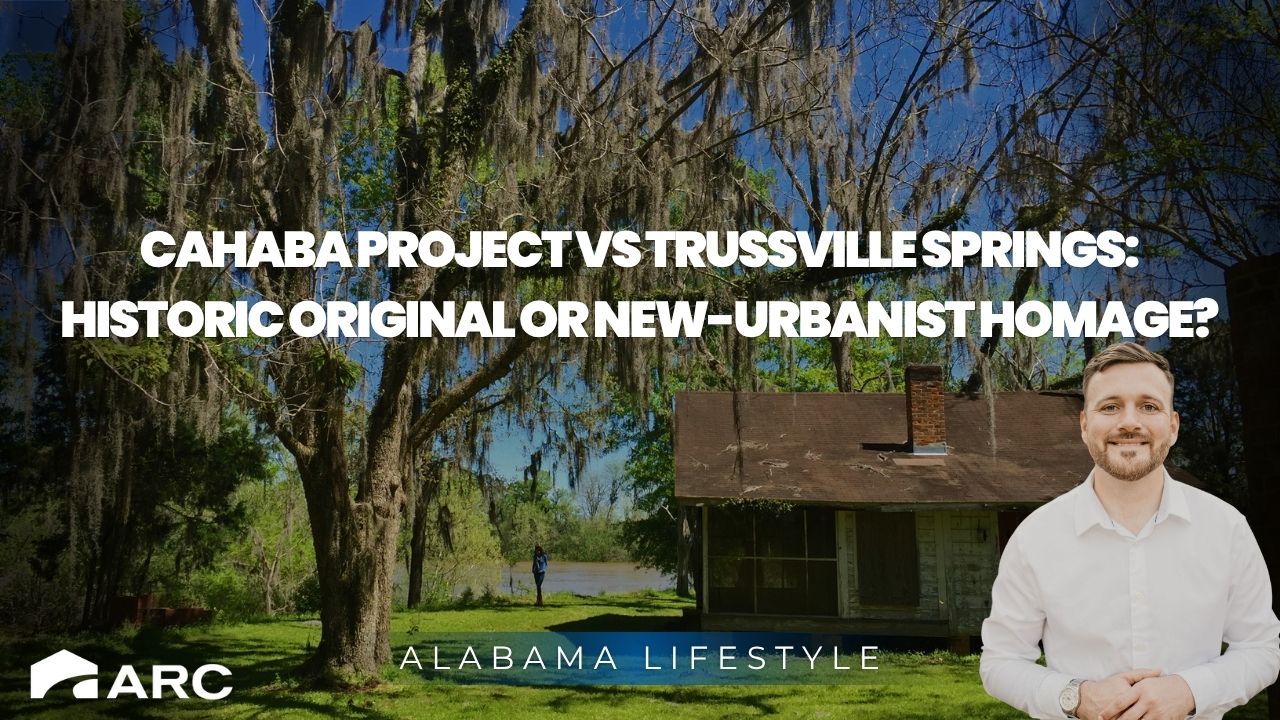
Cahaba Project vs Trussville Springs: Historic Original or New-Urbanist Homage?
Genuine 1930s history or brand-new construction with the same front-porch soul? Comparing two of Trussville’s most distinctive walkable neighborhoods.
The Cahaba Project and Trussville Springs share a walkable, front-porch design philosophy, but one is the genuine 1930s original and the other its brand-new interpretation. The Cahaba Project offers authentic New Deal-era history, roughly 287 character homes around the Mall green, and a walk-to-downtown setting. Trussville Springs offers that same feel with modern cottage and craftsman construction, new-home systems, resort-style amenities, and Cahaba River trails. Both provide Trussville's walkable soul and top schools, so the choice is authenticity versus new-home convenience: own a piece of history and accept historic-home care, or enjoy the character with modern efficiency and HOA-funded amenities. Confirm condition, guidelines or HOA, flood maps, and schools. For help choosing, call Christian Kelly at (205) 902-4320.
On this page
Historic Original vs New-Urbanist Homage
The Cahaba Project and Trussville Springs share a design philosophy — front porches, sidewalks, and a walkable, connected feel — but one is the genuine 1930s original and the other is its brand-new interpretation. Choosing between them is a choice between historic authenticity and new-construction peace of mind.
The Cahaba Project
Trussville’s historic 1930s planned district, with roughly 287 character homes around the Mall green, near Historic Downtown. See the Cahaba Project guide.
Trussville Springs
A new-urbanist community of cottage and craftsman new construction by the Cahaba River, recreating the front-porch feel with modern floor plans and amenities. See the Trussville Springs guide.
Head-to-Head: How They Compare
- Era — Cahaba Project is genuine 1930s; Trussville Springs is brand-new construction
- Homes — historic cottages and multi-family vs modern cottage/craftsman homes and townhomes
- Systems — older homes needing care vs new-home efficiency and warranties
- Amenities — the Mall green and downtown proximity vs pool, pavilion, and river trails
- HOA — minimal in the historic district vs HOA dues in Trussville Springs
Character, Convenience & the Real Decision
Since both offer the same walkable, front-porch spirit, the choice comes down to authenticity versus new-home convenience.
Authenticity vs newness
The Cahaba Project offers something no new build can replicate: genuine New Deal-era history, a storied central green, and decades of mature character. Trussville Springs offers that feel without the historic-home maintenance — new systems, modern layouts, and efficiency. If owning a piece of Trussville history matters most, the Cahaba Project wins; if you want the feel with new-home peace of mind, Trussville Springs delivers.
Maintenance and cost of ownership
Historic homes carry historic-home realities: older systems, potential renovation, and possible historic guidelines. New construction in Trussville Springs minimizes near-term maintenance but adds HOA dues for amenities. Weigh the likely renovation and upkeep of an older home against the fees and newer-home costs of Trussville Springs.
Setting and amenities
The Cahaba Project puts you at the historic heart, walkable to downtown and the Entertainment District. Trussville Springs offers resort-style amenities and Cahaba River trails within the community. Both are walkable and connected; they simply center on different things — downtown history versus community amenities.
The Real Insight — Own the History or Enjoy the Homage
The clearest way to decide: if you want genuine 1930s history, a storied green, and a walk-to-downtown setting — and you’re comfortable with historic-home care — choose the Cahaba Project. If you want that same front-porch character with new-home systems, modern floor plans, and amenities, choose Trussville Springs.
Both give you Trussville’s walkable soul and top schools. This is authenticity versus convenience, not better versus worse. Own the history, or enjoy the beautifully built homage.
What to Verify When Choosing
- Home condition — historic systems in the Cahaba Project; builder/finishes in Trussville Springs
- Historic guidelines in the Cahaba Project; HOA coverage in Trussville Springs
- Flood zone — pull the FEMA map for both, given Cahaba River proximity
- School zoning for the specific address — confirm with the district
- Comparable sales in each specific community
Frequently Asked Questions
What is the difference between the Cahaba Project and Trussville Springs?+
Which is better, the Cahaba Project or Trussville Springs?+
Is Trussville Springs based on the Cahaba Project?+
Which has lower maintenance, the Cahaba Project or Trussville Springs?+
Do the Cahaba Project and Trussville Springs have HOA fees?+
Are both the Cahaba Project and Trussville Springs walkable?+
History or Homage?
Both give you Trussville’s walkable soul and top schools — the choice is genuine 1930s history versus new-construction convenience. I’ll help you weigh authenticity against maintenance, evaluate condition and HOA or historic guidelines, check flood maps, confirm schools, and compare sales. Call before you tour and we’ll find your fit.
Call or text direct: (205) 902-4320
Christian Kelly, Associate Broker
ARC Realty
In real estate since 2018 · Top producer across Greater Birmingham
4501 Pine Tree Cir, Vestavia Hills, AL 35243 · AL License #000116513-0
(205) 902-4320
Information is deemed reliable but not guaranteed. Trussville neighborhood statistics, home values, school rankings, and zoning change over time and should be independently verified. Home value ranges are representative and vary by source, neighborhood, home age, and market timing; confirm current figures and comparable sales with Christian Kelly. School zoning should be confirmed directly with Trussville City Schools for any specific address, as attendance zones are not determined by neighborhood name. Some low-lying and riverfront properties near the Cahaba River may carry flood risk; always review the current FEMA flood map for a specific address. Central Alabama is subject to severe weather; confirm insurance and any storm-shelter details as part of due diligence. Christian Kelly is a licensed associate broker with ARC Realty serving Greater Birmingham, including Trussville, Homewood, Mountain Brook, Vestavia Hills, Hoover, and surrounding Jefferson, St. Clair, and Shelby County communities. Equal Housing Opportunity.